
Sambo is an acronym before it is a martial art. The word compresses the Russian phrase SAMozashchita Bez Oruzhiya, meaning self defense without weapons, and that bureaucratic name tells you exactly what it was: a state project. In the 1920s and 1930s the Soviet Union wanted a standardized hand to hand system for its police, border guards, and army. What it got instead was a competitive grappling sport that would go on to produce some of the most dangerous fighters of the modern MMA era.
Two Founders Who Never Worked Together
Most martial arts trace back to a single teacher. Sambo has two, and they were building different things in different cities.
Viktor Spiridonov was a veteran of the Russo-Japanese War who came to unarmed combat through jujutsu and through the practical demands of policing. He taught at Dinamo, the sports society attached to the Soviet security services, and his system leaned toward pain compliance, joint control, and restraint techniques rather than sport competition. He favored economy of effort and using an opponent’s momentum, which suited a smaller instructor working with officers rather than athletes.
Vasili Oshchepkov came at it from the source. Born on Sakhalin and educated in Japan, he trained at the Kodokan in Tokyo and became one of the first Russians to earn a judo black belt. He taught in Vladivostok, then Novosibirsk, then Moscow, where he ran instruction at the Central Institute of Physical Culture. His version was recognizably judo, adapted for Soviet needs and stripped of its Japanese ceremonial layer. If you want to understand the technical spine of sambo, start with how Jigoro Kano assembled judo from older jujutsu schools, because Oshchepkov imported that curriculum wholesale.
The political ending is grim. Oshchepkov was arrested during the purges of 1937 and died in custody. For decades his name was inconvenient in official Soviet histories, and credit drifted elsewhere.
Kharlampiev and the Folk Wrestling Survey
Anatoly Kharlampiev, a student of Oshchepkov, is the figure most often called the father of sambo, partly because he survived and kept organizing. His contribution was not inventing throws but cataloging them. He traveled across the Soviet republics documenting regional wrestling traditions and folding what worked into a single ruleset.
Those traditions were not a footnote. Georgian chidaoba, Armenian kokh, Tatar and Uzbek belt wrestling, Moldovan trinta, and Azerbaijani gulesh each brought their own gripping habits and throwing mechanics. Jacket wrestling was already the common language of half of Eurasia, so a jacket based competitive sport had a ready talent pool. This is the same pattern that shows up across the long history of wrestling as a combat sport: local folk styles get codified into something exportable once a governing body writes the rules down.
In 1938 Soviet sport authorities formally recognized the sport, and national championships followed. Sambo became a fixture of military and police physical training at the same time it became something athletes could win medals in.
What Sport Sambo Actually Looks Like
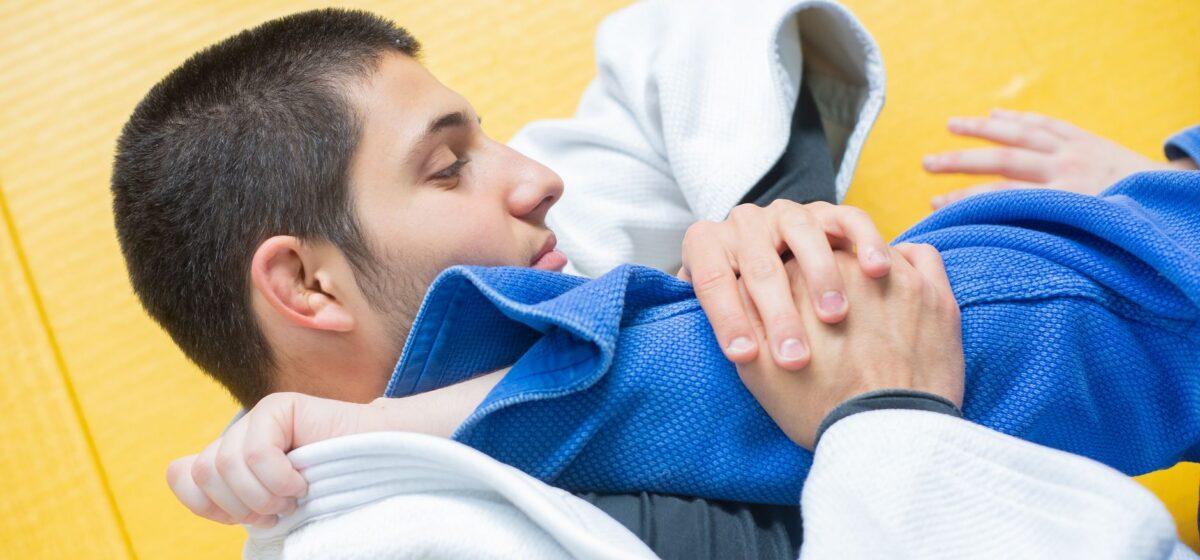
The uniform tells you most of it. Competitors wear a kurtka, a short jacket with belt loops that allow gripping at the shoulders and waist, along with shorts and soft wrestling boots called sambovki. The jacket grip is closer to a judo lapel game than to freestyle wrestling, but the shorts and boots change the range and make leg attacks natural.
Two rule quirks define the style more than anything else:
- Leg locks are central. Straight ankle locks, kneebars, and leg entanglements are legal and heavily trained, which is why sambo practitioners historically arrived in submission grappling with a lower body game most opponents had never seen.
- Chokes are not part of sport sambo. Strangles are excluded from the sport ruleset, which pushes scoring toward throws and joint locks. Combat sambo restores them.
Scoring rewards the throw above all. A throw that puts the opponent squarely on the back while the thrower stays standing ends the match outright as a total victory. That single rule shapes training: sambo players drill for clean, committed, upright finishes rather than for rolling scrambles.
Sport Sambo Versus Combat Sambo
| Element | Sport Sambo | Combat Sambo |
|---|---|---|
| Striking | None | Punches, kicks, knees, elbows |
| Chokes | Not permitted | Permitted |
| Leg locks | Permitted and emphasized | Permitted |
| Gear | Kurtka, shorts, boots | Kurtka plus gloves, headgear, shin guards |
| Closest analogue | Jacketed wrestling with leg locks | Amateur MMA in a jacket |
A Rough Timeline
| Period | Development |
|---|---|
| 1910s | Oshchepkov trains at the Kodokan in Tokyo and earns a judo black belt |
| 1920s | Spiridonov develops a self defense curriculum for Dinamo and Soviet police |
| Early 1930s | Oshchepkov teaches his judo based system in Moscow, training the next generation |
| 1937 | Oshchepkov is arrested during the purges and dies in custody |
| 1938 | Soviet sport authorities recognize sambo as an official sport |
| 1966 | The international wrestling federation recognizes sambo as a wrestling style |
| 1973 | First world championships are held in Tehran |
| 1984 | The International Sambo Federation is established as the sport’s own governing body |
| 2000s | Combat sambo world championships expand the sport’s striking division |
| 2021 | The IOC grants the international federation permanent recognition |
Sambo’s Second Life in Mixed Martial Arts
When MMA went global in the 1990s and 2000s, sambo turned out to be unusually well suited to it. Oleg Taktarov won an early UFC tournament. Fedor Emelianenko built a decade of heavyweight dominance on a base of sambo throws, ground and pound, and armbars that arrived from positions other heavyweights considered safe. Khabib Nurmagomedov, a world combat sambo champion before he was a UFC champion, made a career out of the same principle: take the jacket away and the underlying skill of controlling a resisting body from the clinch to the mat still holds.
The transferable pieces are specific. Sambo produces fighters who are comfortable initiating from grips, who chase the total victory throw rather than settling for a positional stall, and who treat the legs as legitimate targets. It produces fewer natural strikers, which is why the strongest sambo based MMA careers usually pair the grappling with a separate boxing or kickboxing education.
Why It Has Not Reached the Olympics
Sambo received provisional recognition from the International Olympic Committee in 2018 and permanent recognition in 2021. Recognition is not the same as inclusion. It means the IOC acknowledges the governing body and its rules, which opens doors to funding, anti doping structures, and multi sport games, but it does not put the sport on the Olympic program.
The obstacles are practical and political. Sambo overlaps heavily with judo and wrestling, both already on the program, and the IOC has been reducing rather than adding grappling weight classes. The sport’s close identification with Russia has also complicated its international standing since 2022. What sambo has instead is influence, which is arguably worth more. Its techniques and its athletes are embedded in modern MMA, and its history is a useful reminder that martial arts are usually assembled rather than discovered.