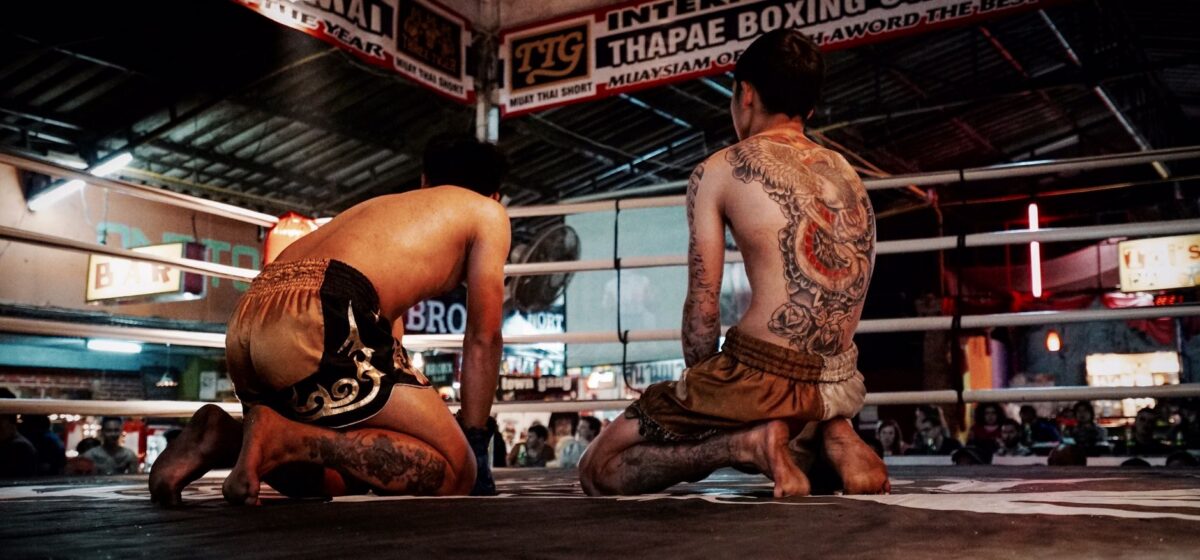

Few combat sports carry their history as openly as Muay Thai. Every fighter who steps through the ropes performs a slow ritual dance before the first bell, a gesture that reaches back centuries to the battlefields of old Siam. The sport now fills arenas from Bangkok to Las Vegas and shapes the striking of nearly every modern mixed martial artist, yet its core has changed remarkably little. It remains a close quarters style built around the clinch, the elbow, and the knee.
From Battlefield Art to National Pastime
Muay Thai grew out of the military training of the Siamese kingdoms. As armies fought with swords, spears, and staffs, soldiers also drilled unarmed combat for the moment a weapon was lost or a battle collapsed into a brawl. These methods were gathered under the broad name Muay Boran, meaning ancient boxing, which covered regional styles taught across the country.
By the Ayutthaya period, which ran from the middle of the fourteenth century until 1767, fighting had moved beyond pure warfare. Bouts were staged at festivals and temple fairs, skilled boxers won the favor of kings, and a talented fighter could gain status that crossed class lines. The sport was woven into Thai life long before it ever had formal rules.
The Legend of Nai Khanom Tom
No figure looms larger in the sport’s origin story than Nai Khanom Tom. According to tradition, he was a Siamese boxer captured when the Burmese sacked Ayutthaya in 1767. The legend holds that in 1774 the Burmese king staged a contest to test Siamese boxing against his own champions, and that Nai Khanom Tom was sent into the ring to fight for his freedom.
Before fighting, he is said to have performed the wai kru ram muay, the ritual dance that honors a fighter’s teachers and ancestors, then defeated one opponent after another. Thailand celebrates him every March 17, a date observed as National Muay Thai Day, also known as Nai Khanom Tom Day. Historians treat the finer details as folklore, but the story captures how deeply the sport is tied to national identity.
The Art of Eight Limbs
Muay Thai earns its nickname, the art of eight limbs, from the eight points of contact a fighter is allowed to strike with. Where Western boxing uses two fists and most kickboxing adds the feet, Muay Thai turns the whole body into a weapon.
| Weapon | How it is used |
|---|---|
| Two fists | Jabs, crosses, hooks, and uppercuts, much of it borrowed from Western boxing |
| Two elbows | Short, slashing blows that cut and stun inside the pocket |
| Two knees | Driven into the body and head, especially from the clinch |
| Two shins | Roundhouse kicks and the teep, or push kick, used to control distance |
The clinch sets Muay Thai apart from most striking styles. Fighters grip behind the neck and arms to control posture, then land knees and elbows or sweep an opponent off balance. Scoring traditionally rewards balance, control, and damaging blows over sheer volume, which is why a single clean elbow or a fighter who dominates the clinch can decide a round.
From Rope Fists to a Codified Sport
For much of its history, Muay Thai was fought with kard chuek, lengths of hemp rope wound around the hands and forearms. The reign of King Chulalongkorn, from 1868 to 1910, is often described as a golden age, when royal interest helped spread the sport and elevate its champions.
Modernization arrived in the early twentieth century. Influenced by Western boxing, promoters adopted padded gloves, a roped ring, timed rounds, and weight classes, and the dangerous bouts fought with bound rope faded away. Permanent venues gave the sport a home. Rajadamnern Stadium opened in Bangkok in 1945 and Lumpinee Stadium followed in 1956, and the two became the most prestigious arenas in the sport. When the country changed its name from Siam to Thailand in 1939, the art increasingly became known by the name the world uses today.
A Global Sport
Muay Thai’s reach widened dramatically in the late twentieth century. In the Netherlands, gyms blended Muay Thai with Kyokushin karate and Western boxing to create the aggressive style now known as Dutch kickboxing. In Japan, the K-1 promotion launched in 1993 and brought elite strikers from several disciplines onto one stage, often under rules drawn from Muay Thai.
The sport’s biggest modern impact may be inside the cage. When mixed martial arts went mainstream, the clinch, the low kick, the teep, and the cutting elbows of Muay Thai became standard tools for any complete striker. Fans who want to understand why a boxer and a mixed martial artist hit so differently can see those fingerprints clearly in our breakdown of how striking in boxing and MMA is not the same. The forward pressure and relentless body attack that define elite Thai fighters also rhyme with the Mexican style built on pressure and the liver shot.
Recognition has followed the sport’s growth. The International Olympic Committee granted the International Federation of Muaythai Associations full recognition in 2021, a milestone that was reported as a major step in the sport’s long pursuit of an Olympic place. From a battlefield skill to a stadium spectacle to a recognized international sport, Muay Thai has traveled a long road while keeping the rituals and weapons that made it.