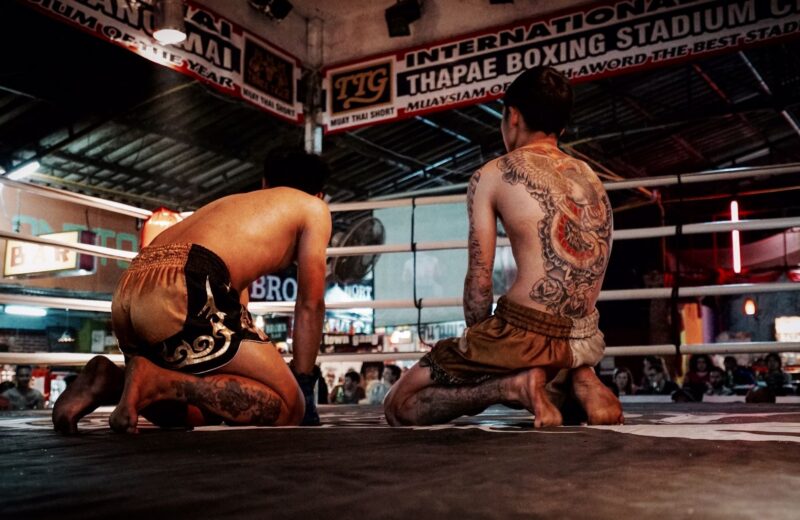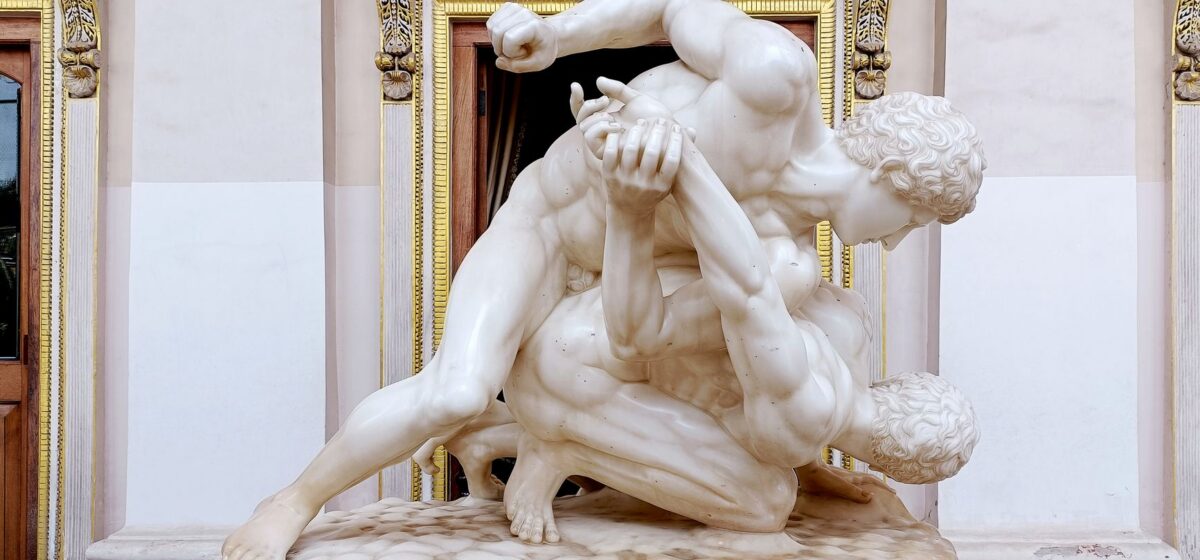

No combat sport has a longer paper trail than wrestling. Long before boxing gloves or padded rings existed, two people tested strength, leverage, and will by trying to put each other on the ground. Cave drawings, clay tablets, and marble reliefs all record the same basic contest, and that contest never really disappeared. It simply changed clothes. Follow the thread from the ancient Mediterranean to a modern cage and you can watch the same skills survive thousands of years of reinvention.
The Ancient Foundation
Organized wrestling reaches back to at least the third millennium BCE, with evidence appearing in Sumerian and Egyptian art. It found its most famous home in ancient Greece, where wrestling, called pale, was a central event of the ancient Olympic Games. Greek wrestling rewarded a competitor who scored a set number of clean throws, forcing an opponent’s back, shoulder, or hip to the ground. It also formed part of pankration, a brutal blend of striking and grappling that some historians consider the earliest recorded mixed combat sport.
For the Greeks, wrestling was not only sport. It was education. Training grounds called palaestrae sat at the heart of civic life, and philosophers used wrestling as a metaphor for argument and virtue. The documented history of the discipline shows how deeply the practice was woven into daily culture, not treated as a fringe spectacle.
From Folk Style to Codified Sport
After the ancient world, wrestling survived as folk tradition. Nearly every region developed its own version, from the belt wrestling of Central Asia to the collar and elbow style of Ireland and the Lancashire tradition of northern England. These local forms shared rules by word of mouth and varied from village to village, which made a truly standardized sport impossible for centuries.
Formal codification arrived in the modern era. When the Olympic Games were revived in 1896, wrestling returned with them, and international bodies gradually settled on two competitive styles that still dominate today.
| Style | Core rule | Origin note |
|---|---|---|
| Greco Roman | Holds allowed only above the waist, no attacking the legs | Shaped in 19th century continental Europe |
| Freestyle | Legs may be used to attack, trip, and defend | Grew from British and American folk styles |
The Olympic record of the sport shows Greco Roman debuting in the modern Games first, with freestyle joining shortly after at the 1904 Games in St. Louis. Women’s freestyle wrestling was not added to the Olympic program until 2004, a reminder of how recently the sport opened its most prestigious stage to half the population.
Catch as Catch Can and the Carnival Circuit
Parallel to the amateur Olympic tradition ran a rougher cousin. Catch as catch can wrestling, usually shortened to catch wrestling, developed in the carnivals and music halls of Britain and America during the late 19th and early 20th centuries. Catch allowed submission holds, joint locks, and pins, which meant a match could end by force rather than points.
This is the branch that matters most for modern fighting. Carnival wrestlers traveled with troupes and took on all comers, which meant they needed reliable ways to control and finish untrained challengers quickly. Catch wrestling spread through professional circuits and eventually influenced grappling in Japan, where it helped seed the submission traditions that later fed into mixed martial arts.
Why Wrestling Rules Modern MMA
When the Ultimate Fighting Championship staged its first event in 1993, it advertised itself as a test to find the most effective fighting style. The early tournaments delivered an unexpected lesson. Fighters who could decide where a bout took place, standing or on the ground, controlled almost everything else. Wrestling supplied exactly that control.
A wrestler chooses the range. He can take a striker down and neutralize dangerous punches, or he can stay upright and stuff every takedown attempt to keep the fight standing. This is why so many champions across weight classes come from collegiate and international wrestling backgrounds. The skill does not always produce highlight knockouts, but it dictates the terms of the contest, and terms usually decide winners.
That dominance also reshaped how strikers train. A boxer stepping into MMA quickly learns that punching alone is not enough, a theme explored in our look at why striking in the cage differs from the ring. Fighters now blend disciplines rather than defend a single style, echoing the way older arts absorbed each other over time. The same pattern of a battlefield practice becoming a global sport appears in our history of Muay Thai and its journey to worldwide competition.
Wrestling as the Original Combat Science
What ties Olympia to the Octagon is not a specific hold or throw. It is a principle. Control the position and you control the fight. Ancient Greeks understood it, carnival showmen exploited it, and modern cage fighters build entire game plans around it. Wrestling endures because it answers the most basic question in any physical confrontation, which is who gets to decide what happens next.
The sport still evolves. Freestyle rules are tweaked, submission grappling grows its own following, and coaches keep refining how athletes build the strength and balance that takedowns demand. Yet the core has barely moved in three thousand years. Few human activities can claim that kind of continuity, and fewer still remain as relevant to elite competition today as they were when the first Olympians grappled on the sand.